7 Steps to Start Forex Trading for Beginners Without Blowing Your First Account
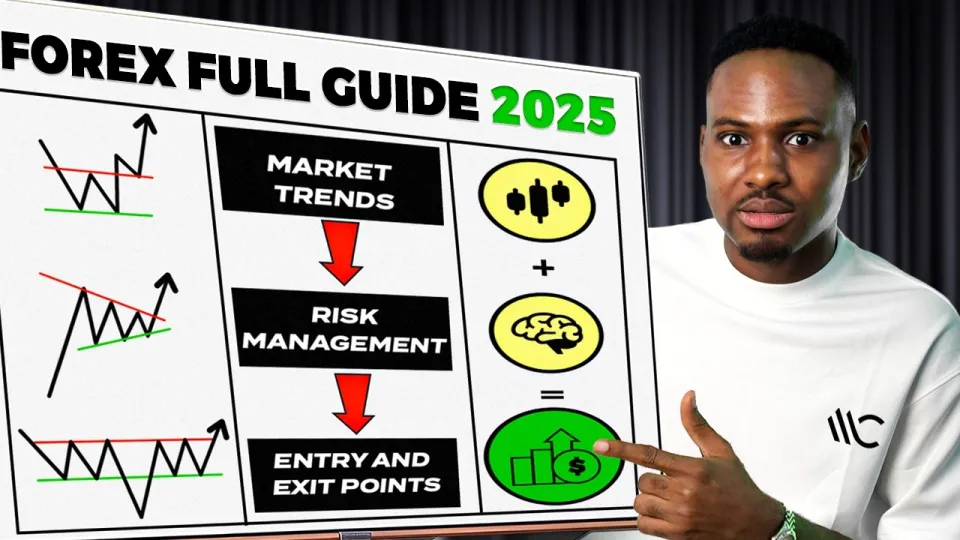
Video: How To Start Forex Trading For Beginners’ 2025 (Full Course)
You can order the same kind of articles for your own video to boost it on YouTube and Google. Just message the Telegram bot @sat_sit_bot. It writes articles around your video, embeds the video and publishes them on popular niche websites (no ads). Try it free: 50 articles on us.
· based on the channel Jeffrey Benson Forex
Forex is the global market where national currencies are exchanged in pairs, and a beginner starts trading it by opening a demo account, learning one chart platform such as MT5, defining risk at 1–2% per trade and placing a first small position with a stop loss. You do not need a large deposit or a banking background to begin — you need a process. Jeffrey Benson Forex builds a full beginner course around exactly that idea, and the student plan behind it is available at firepipsfx.com/plans.
What forex trading actually is and how the market works
Forex trading is the act of buying one currency while selling another, and the price you see is simply the exchange rate between the two. Every quote has a base currency and a quote currency: in EUR/USD, the euro is the base and the dollar is the quote, so a price of 1.0850 means one euro costs 1.0850 dollars.
Three structural facts shape everything else a beginner does:
- It is an over-the-counter market. There is no single exchange. Banks, brokers and liquidity providers are linked through a network, and your broker passes your order into that network.
- It runs nearly 24 hours a day, five days a week. Trading opens in Sydney on Sunday evening and closes in New York on Friday evening, moving through the Sydney, Tokyo, London and New York sessions.
- Leverage is built in. A broker may let you control a $10,000 position with $100 of margin. That amplifies both gains and losses, which is why position sizing matters more than prediction.
Currency prices are driven by interest rates, inflation data, central-bank decisions, employment reports and risk sentiment. A beginner does not need to forecast these; you need to recognise when volatility is scheduled and either trade deliberately or stay out.
The tools every beginner needs before the first trade
The minimum toolkit for starting forex is a regulated broker account, a trading platform, a demo account and a journal. Everything else is optional.
- A broker. Check regulation, spreads on the pairs you intend to trade, execution quality and withdrawal terms. The channel behind this course points beginners to Assex Markets and its MT5 setup guide, but the checklist matters more than the brand: verify the licence, test a small withdrawal early, and read the leverage terms.
- MetaTrader 5 (MT5). The platform where you place orders, set stop loss and take profit, and review history. Learn five functions first: market order, pending order, stop loss, take profit and the position tab. Nothing else is required on day one.
- A demo account. Trade the same pairs and lot sizes you plan to use with real money. The goal is not profit on demo — it is proving you can follow your own rules for 20–30 trades.
- A notebook or trading journal. Record the pair, direction, entry, stop, target, lot size and the reason for the trade. Reviewing 20 logged trades teaches more than watching 20 more videos.
- A calculator. Position size is arithmetic, not intuition. Lot size = (account risk in money) ÷ (stop distance in pips × pip value).
A basic strategy foundation you can actually follow
A workable beginner strategy is a rule set for when to enter, where to exit and how much to risk — not a prediction of where price will go. Most simple frameworks combine three layers: direction, level and trigger.
Direction. Use one higher timeframe, such as the daily chart, to decide whether price is making higher highs and higher lows or lower highs and lower lows. Trade with that structure rather than against it.
Level. Mark the obvious zones where price previously reversed or consolidated: prior swing highs and lows, round numbers, and the high and low of the previous day. These are the places where orders cluster.
Trigger. On a lower timeframe, wait for price to reach your level and then show a clear reaction — a strong close back in the direction of the higher-timeframe trend, for example. Enter after the reaction, not in anticipation of it.
Then define the trade in numbers before you click: entry, stop loss beyond the level that would prove you wrong, and a target of at least 1.5–2 times the stop distance. A strategy with a 1:2 reward-to-risk ratio can be profitable while winning only 40% of the time, which is why beginners should stop chasing high win rates.
How to place your first forex trade step by step
Placing a first trade is a short checklist, and following it in order prevents the most common beginner error: entering first and calculating risk afterwards.
- Pick one major pair, such as EUR/USD, and one timeframe for entries.
- Decide your maximum risk for the trade in money — 1% of a $1,000 account is $10.
- Measure the stop distance in pips from entry to the invalidation level.
- Convert that into lot size using pip value; on a standard lot of EUR/USD, one pip is roughly $10, so a 20-pip stop with $10 of risk means 0.05 lots.
- Set stop loss and take profit in the order ticket before confirming.
- Screenshot the chart and write the trade in your journal.
- Leave the position alone until price hits the stop, the target, or your pre-written time-based exit.
On a demo account, repeat this until the mechanics feel boring. Boredom is the sign that execution has become routine.
Common mistakes that empty beginner accounts
The fastest way to lose money in forex is to treat leverage as a shortcut and risk management as an afterthought. The recurring failures are consistent across almost every new trader.
- Oversized positions. Risking 10–20% per trade means five bad trades can end the account. Cap risk at 1–2%.
- Trading without a stop loss. A stop loss is the only thing that defines the maximum cost of being wrong.
- Revenge trading. Doubling size after a loss to recover it turns one loss into a losing streak.
- Overtrading. Sitting in front of charts for hours produces low-quality entries; two or three planned setups a week is enough.
- Copying signals blindly. Copying trades without understanding the entry, stop and risk means you cannot manage the position when the signal author is asleep.
- Skipping the journal. Without records, you cannot tell whether a losing month was bad strategy or bad execution.
Beginner questions answered in practice
Beginners usually ask the same practical questions, and the answers are less dramatic than the marketing suggests. A small account is not a barrier — it is a limit on expectations, because 2% of $200 is $4 per trade, which will not replace an income. Demo trading is not a waste of time if it is time-boxed: 20–30 logged trades, then a small live account to feel real slippage and real emotion. Signal groups are useful for learning structure but not for learning risk, since the person copying has to size the position themselves. And no strategy removes losses: a professional edge is a small statistical advantage repeated over hundreds of trades, not a run of wins.
Useful links from the course
- Student plans and full training: firepipsfx.com/plans
- Free daily signal channel: https://t.me/firepipsignals
- Broker registration used in the course: https://my.assexmarkets.com/auth/register?partner_code=1699134
- Premium signal group access: https://t.me/jeffreybenzhelpbot
Bottom line
Forex for beginners comes down to a small number of decisions made consistently: choose a regulated broker, learn one platform, risk 1–2% per trade, trade one strategy with a defined stop and record everything. The full course from Jeffrey Benson Forex is built on that same order — market basics, tools, strategy, first trade, then mistakes — and it is worth working through with a notebook open rather than as background video. Progress comes from executed repetitions on demo, not from more information. When you are ready to formalise the process, the student plans are at firepipsfx.com/plans.
Key takeaways
- Forex is the market where national currencies are traded in pairs, such as EUR/USD, around the clock from Monday to Friday.
- Beginners need three things before risking money: a demo account, a charting platform like MT5 and a written trading plan.
- Risk per trade should stay at 1–2% of the account; a 2% risk on a $500 account means $10 at stake, not a random lot size.
- The four trading sessions are Sydney, Tokyo, London and New York; London–New York overlap is the most liquid window.
- Most beginner losses come from oversized lots, no stop loss, revenge trading and copying signal groups instead of learning the process.
Source: How To Start Forex Trading For Beginners’ 2025 (Full Course) · Markdown version
Questions & answers
How much money do I need to start forex trading?
You can open a live account with a few hundred dollars, but the practical minimum depends on your risk rule. At 1–2% risk per trade, a $500 account risks $5–10 per position, which limits position size rather than opportunity. Start on demo until your execution is consistent, then fund an amount you can afford to lose entirely.
Is forex trading suitable for a complete beginner?
Yes, provided you treat it as a skill built over months rather than a shortcut to income. The mechanics — orders, stop loss, lot size — can be learned in a few weeks; the discipline to follow a plan takes longer. Most losses come from oversized positions and missing stop losses, not from a lack of market knowledge.
How long does it take to become profitable?
There is no fixed timeline, and anyone promising one is guessing. A realistic path is several months of demo and small live trading with a written journal, enough to gather 50–100 trades and see whether your rules produce an edge. Consistency of process usually arrives before consistency of profit.
Can I just copy trades from a signal group instead of learning?
Copying is possible, but you still control the lot size, the stop and the decision to hold or close, so risk management remains yours. Signals are more useful as examples of structure than as a substitute for understanding. Learn why a trade exists before copying it.